How East West Rail would benefit Cambridge
Home to an internationally renowned life sciences cluster, as well as leading robotics and fintech companies, Cambridge is a powerhouse of innovation, bringing prosperity to the area and the UK. But, it’s being held back by constrained growth. EWR would provide better connectivity and ease the pressure on the city, helping Cambridge grow in a way that benefits everyone. It would open up more options for lab and office space, generate local jobs and open up access to homes.
The new line would make it easier for people to get around the Cambridge area, travel across the region and access the rest of the UK with faster, greener journeys. These include travelling to attractions such as Universal United Kingdom Resort near Bedford which will be served by a new station at Stewartby; the Second World War codebreakers’ home at Bletchley Park; Stadium MK – the home of Milton Keynes Dons Football Club and also a concert venue able to host 35,000 people – and designer outlet shopping centre Bicester Village. East West Rail will also connect with five major rail routes, enabling people to visit attractions and destinations further afield.
Our latest proposals
The upgrade of the existing railway to four tracks would continue north from Addenbrooke’s Road to Cambridge station. The majority of the land that would be required is already owned by Network Rail. At the new Cambridge South station, currently being built by Network Rail, we would tie‑in with the existing four‑track configuration. No alterations are proposed at Cambridge South. North of Cambridge South station, the new tracks would pass beneath the existing Cambridgeshire Guided Busway bridge. Busway operations would be unaffected by our works.
At Long Road the existing A1134 bridge would be replaced with a wider bridge to accommodate the extra tracks. We have tested multiple options for how best to replace this bridge and add the new tracks beneath, given that Long Road is a key route within Cambridge and the West Anglia Main Line is a busy rail corridor. We have taken the decision to fully close the road to rebuild the bridge for a period of six to thirteen weeks.
Construction of the proposed rail corridor to support the twin‑track installation from Addenbrooke’s Road to Cambridge station would be enabled by several construction compounds. These would include compounds to the south‑west of Long Road, within the sports fields of St Mary’s School, and on both sides of the railway at Cambridge station. A further compound would be placed in the sports ground next to Long Road and Sedley Taylor Road.
You can read more about our proposals in our consultation brochure here.
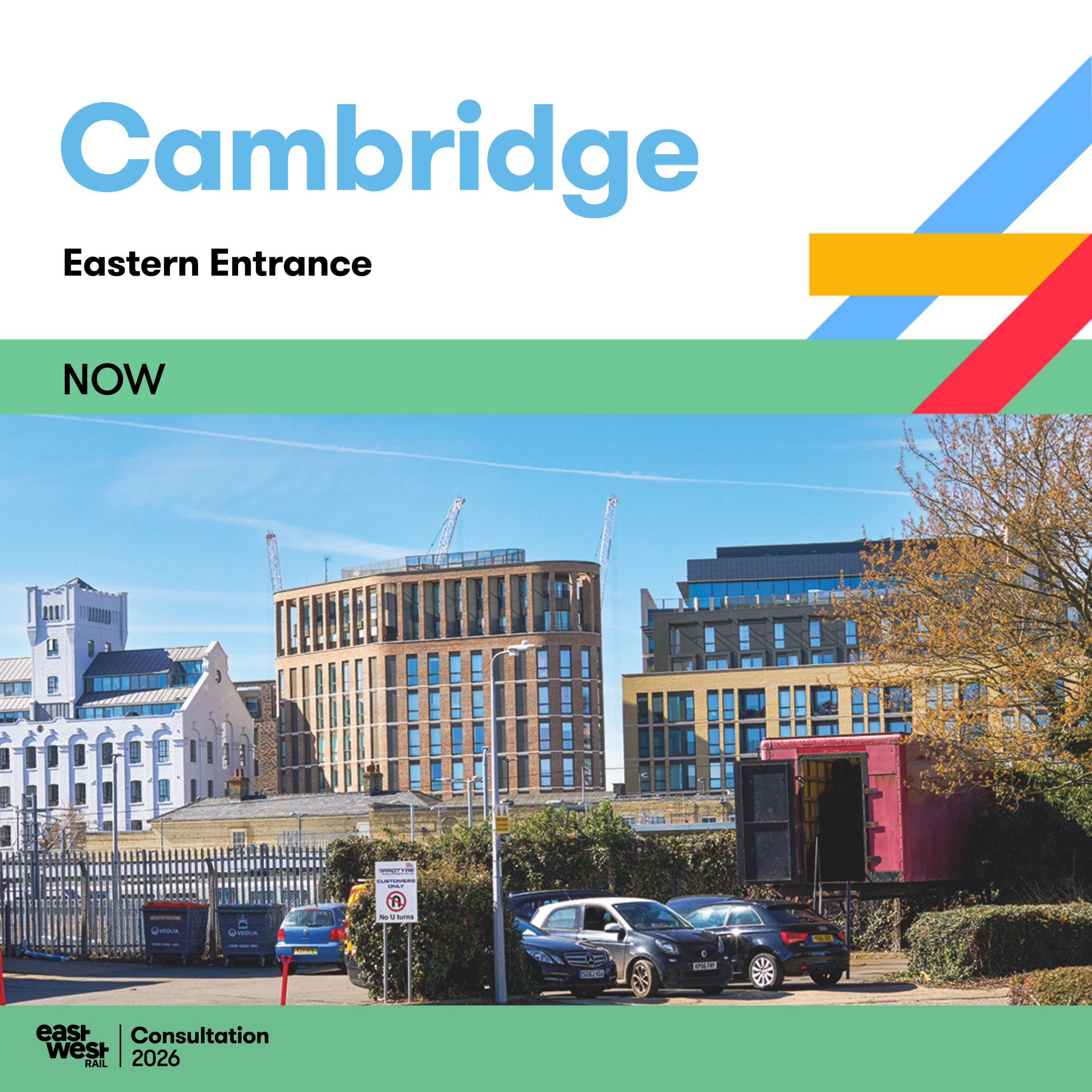
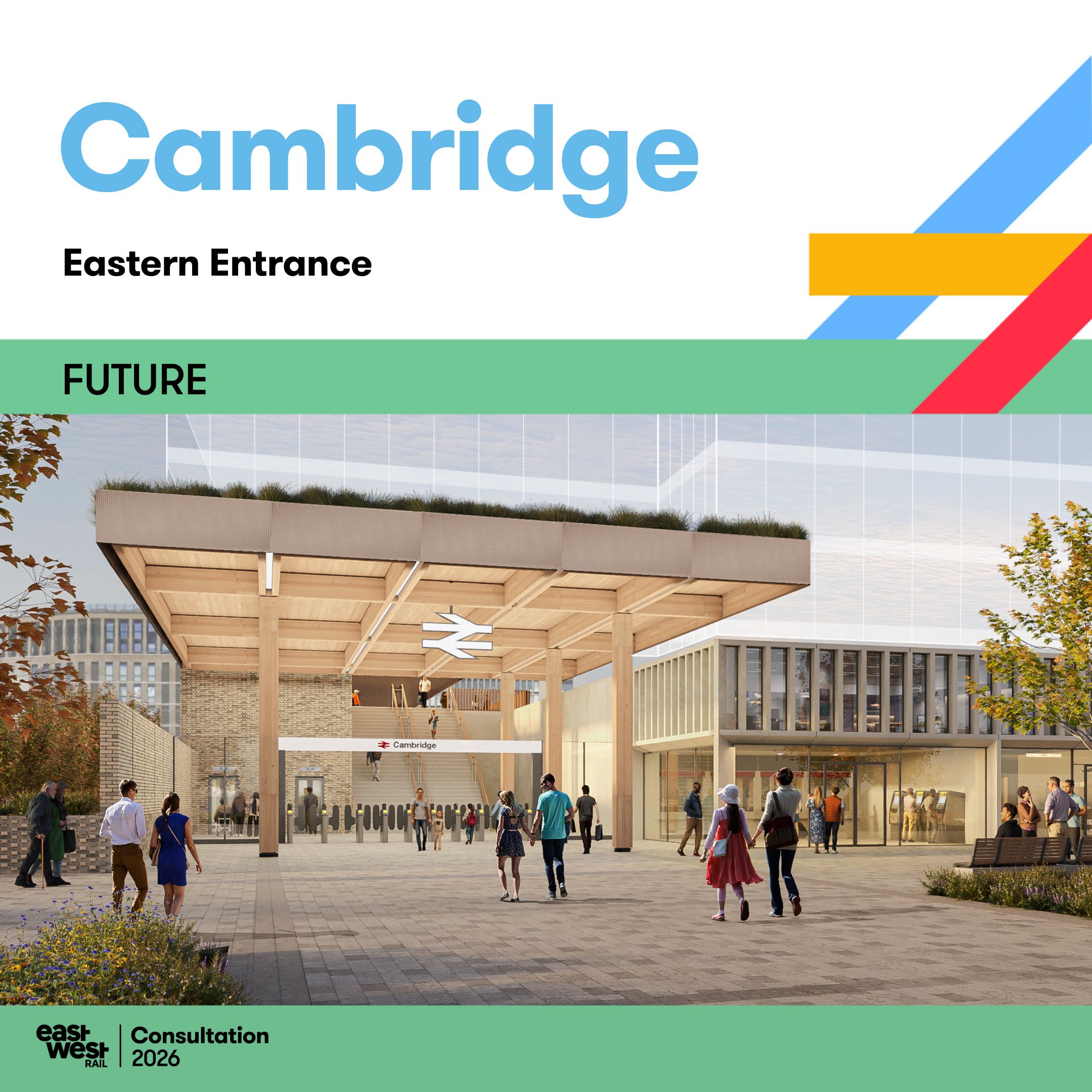
We propose to add a new station entrance on Clifton Road, realising the long‑held ambition to provide an eastern gateway to the station. This would allow a transformational change in how communities access Cambridge station. The new entrance would make the railway more convenient to access and more attractive for residents and local businesses.
The new railway would bring a significant increase in passenger numbers at Cambridge station. The addition of the new eastern entrance would mean some of this increased demand enters and exits the station from the east side. The inclusion of the eastern entrance therefore means that the amount of upgrade infrastructure works on the west side would be less, with less impact on the Grade II listed building than without the eastern entrance.
The entrance would be fully accessible, providing step‑free access to all platforms. It would also have a new active travel hub with bike storage. Existing bus services, taxi rank, and station car parking would remain on the western side. This new entrance would provide a direct, convenient route for people approaching from the east of the city.
You can read more about our proposals in our consultation brochure here.
Along the Newmarket Line east of Cambridge, we’re proposing a series of coordinated improvements to support additional rail services and improve connectivity in the area. These proposals include twin‑tracking, with an additional track installed within the existing rail corridor from Coldhams Lane Junction eastwards to the turnback location, just to the west of Cherry Hinton High Street level crossing. As with other sections of the route, we are planning to introduce electrification along the Newmarket Line to Fulbourn.
The existing Coldhams Common footbridge would be reconstructed to become wider, enabling us to extend the railway here to two tracks. Coldhams Common is designated as both Common Land and a Local Nature Reserve, and the design of the replacement footbridge has been optimised to reduce land take within the Common. Landscape planting is proposed on the railway embankments to mitigate visual impacts from the upgraded infrastructure, and any habitats temporarily affected during construction would be replaced.
You can read more about our proposals in our consultation brochure here.
Our proposed new station, Cambridge East, would improve connectivity and unlock economic growth in the east of the city. This station would be near Cambridge City Airport and along the existing Newmarket Line, which would be upgraded as part of our wider proposals. This station would serve the villages to the east of Cambridge, as well as planned developments in the area, while reducing pressure on Cambridge station. The provision of Cambridge East station would be subject to third party funding.
The station would be near Cambridge City Airport, which is due to be decommissioned, in an area with strong potential for growth and development. Cambridge East would help stimulate economic growth in the area and would unlock a new connection to the wider region through an upgrade to the Newmarket Line, which would in turn enable connections to existing regional links to Felixstowe and Ipswich.
You can read more about our proposals in our consultation brochure here.
With the preferred location of the train maintenance depot near Bletchley towards the western end of the EWR route, a smaller train care centre is required towards the eastern end to reduce empty train mileage outside normal train service operating hours.
A train care centre would be required to support the day‑to‑day operation of EWR services, including train stabling, cleaning, and routine preparation. We do not expect the train care centre to undertake heavier maintenance activities. Providing these facilities close to where services operate helps to improve reliability and reduces the need for empty train journeys. We have identified Fulbourn as a potential location for the Cambridge Eastern train care centre. However, we are also continuing to work with other train operators in the Cambridge area to explore whether an alternative location might offer better opportunities to reduce construction impacts and improve service reliability when EWR opens.
No decisions have yet been made, and we are continuing to collaborate with regional train operators to explore alternative solutions that might reduce construction impacts and provide better, more reliable services when EWR opens. If our ongoing collaboration with the wider rail industry produces a better solution, we will carry out further engagement with relevant stakeholders and local communities later in 2026.
You can read more about our proposals in our consultation brochure here.
North of Cambridge station the EWR route would continue along the existing railway corridor, passing beneath Mill Road, Coldhams Lane and the A1134 Newmarket Road, before crossing the River Cam on the existing viaduct to approach Cambridge North station.
The design in this area includes updates to the track layout and infrastructure to support EWR while improving operational capability to the north. We do not intend to introduce additional rail services to Cambridge North station. Noise mitigation would be provided between Mill Road and Coldhams Lane.
You can find out more about our proposals in our consultation brochure here.
A brand new Cambridge East station
For the first time in decades, a brand new Cambridge East station will connect communities in the east of Cambridge directly into the city and the wider rail network, opening up new, fast and reliable travel choices for people now and into the future.
The new station will support future housing and employment growth in the east of the city and will help reduce passenger congestion at Cambridge station. Also, the Newmarket Line will be upgraded to improve links through Felixstowe and Ipswich.
It will be easy to reach the new station via walking, wheeling and cycling routes. Step-free platform, clear routes through the station, passenger pick-up and drop-off, bus services and blue-badge parking will make the station easy to access for everyone.
A new eastern entrance for Cambridge station
A transformed Cambridge station will be more spacious, less congested and easier to move around at busy times thanks to upgrades to the concourse, extensions to platforms 7 and 8, a new and accessible platform 9, new footbridges and a brand new eastern entrance from Clifton Road.
By building a new entrance on the eastern side, a whole new quarter of the city would be opened up, not only improving accessibility but also creating an area prime for regeneration offering new business, retail and leisure opportunities.
Residents living to the east of Cambridge station will have a much quicker walk with direct routes linking to a new eastern entrance, avoiding the need to cross Carter Bridge to access the station.
The eastern entrance will be fully accessible with step-free access to all platforms, and a new active travel hub will link into cycle lanes and footpaths, providing secure storage space for hundreds of bicycles, cargo-bikes, and other small vehicles that help to cut congestion and reduce emissions. A passenger pick-up and drop-off area outside the eastern entrance will include accessible spaces for disabled passengers, and new seating and lighting around the station will help make it a welcoming place to be.